
The Stillbirth of Science in Arabia
by Dr. Stacy Trasancos
Filed under Christianity and Science

NOTE: Today we wrap up our weekly series of essays by Dr. Stacy Trasancos on the "stillbirths" of science. They're based on Fr. Stanley L. Jaki's research into the theological history of science in the ancient cultures of Egypt, China, India, Babylon, Greece, and Arabia. See past articles here. The last culture to be examined is that of the Muslims. Although theirs was a monotheistic view, it was not a Christological or Trinitarian view, which left it vulnerable to a monotheism... Read More
If Everything Requires a Cause, What Caused God?
by Dr. Edward Feser
Filed under The Existence of God

W. Norris Clarke’s article, “A Curious Blind Spot in the Anglo-American Tradition of Antitheistic Argument,” first appeared in The Monist in 1970. It was reprinted in his anthology titled The Creative Retrieval of St. Thomas Aquinas: Essays in Thomistic Philosophy, New and Old, which was published posthumously in 2009. I recently read the essay, and I did so with embarrassment and gratification. Embarrassment because I found that something I’ve been harping on for a few... Read More
Aliens, Angels, and the Cosmos
by Fr. Dwight Longenecker
Filed under Cosmology

Are you familiar with the Fermi Paradox? It goes something like this: “There are billions of stars out there like the sun. Therefore, statistically there must be billions of planets like earth where intelligent life has developed. Given the vast amount of time, and the vast number of possible 'other earths,' there must be other intelligent life forms who have invented space travel. Yet while this seems extremely probable, we haven't encountered any." There are several problems with... Read More
The Stillbirth of Science in Greece
by Dr. Stacy Trasancos
Filed under Christianity and Science

NOTE: Today we continue our weekly series of essays by Dr. Stacy Trasancos on the "stillbirths" of science. They're based on Fr. Stanley L. Jaki's research into the theological history of science in the ancient cultures of Egypt, China, India, Babylon, Greece, and Arabia. See past articles here. Like other great civilizations, the contributions and skill of the ancient Greeks cannot be dismissed. Probably more has been written about Greek intellectual history than any other ancient... Read More
Bayes Theorem Proves Jesus Existed (And That He Didn’t)
by Dr. William M. Briggs
Filed under Historicity
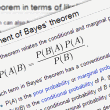
In his shockingly neglected Treatise on Probability, John Maynard Keynes put his finger on the difficulty people have with probability, particularly Bayes’s Theorem: "No other formula in the alchemy of logic has exerted more astonishing powers. For it has established the existence of God from the premiss of total ignorance; and it has measured with numerical precision the probability the sun will rise tomorrow." Probability carries with it “a smack of astrology, of alchemy.”... Read More
Are Omnipotence and Omniscience Incompatible?
by Dr. Edward Feser
Filed under God's Nature

A reader recently asked for my response to this passage from Richard Dawkins’ The God Delusion: "Incidentally, it has not escaped the notice of logicians that omniscience and omnipotence are mutually incompatible. If God is omniscient, he must already know how he is going to intervene to change the course of history using his omnipotence. But that means he can’t change his mind about his intervention, which means he is not omnipotent." (pp. 77-78) We have here a clever rhetorical... Read More
The Stillbirth of Science in Babylon
by Dr. Stacy Trasancos
Filed under Christianity and Science
NOTE: Today we continue our weekly series of essays by Dr. Stacy Trasancos on the "stillbirths" of science. They're based on Fr. Stanley L. Jaki's research into the theological history of science in the ancient cultures of Egypt, China, India, Babylon, Greece, and Arabia. See past articles here. In The Savior of Science, Jaki mentioned the history of science among cultures that communicated and developed in succession–Babylon, Greece, and Arabia. Knowledge was transmitted to... Read More
Why I Love My Invisible Friend
by Bishop Robert Barron
Filed under God's Nature, The Existence of God

One of the favorite taunts of the New Atheists is that religious people believe in an “invisible friend.” They are implying, of course, that religion is little more than a pathetic exercise in wishful thinking, a reversion to childish patterns of projection and self-protection. It is well past time, they say, for believers to grow up, leave their cherished fantasies behind, and face the real world. In offering this characterization, the New Atheists are showing themselves to be disciples... Read More
In Defense of Classical Theism
by Steven Dillon
Filed under The Existence of God

When I first began to study the philosophy of religion, I became acquainted with a certain style of reasoning about God. This style seems to model arguments for and against God after arguments in the natural sciences, and is very much in vogue today. Herman Philipse is representative when he says that "the methodological dilemma for natural theologians in contemporary Western culture is that they either have to opt for methods of factual research that are intellectually respectable in... Read More
The Stillbirth of Science in India
by Dr. Stacy Trasancos
Filed under Christianity and Science

NOTE: Today we continue our weekly series of essays by Dr. Stacy Trasancos on the "stillbirths" of science. They're based on Fr. Stanley L. Jaki's research into the theological history of science in the ancient cultures of Egypt, China, India, Babylon, Greece, and Arabia. See past articles here. The decimal system and notation developed in ancient India between the fourth and seventh centuries represents “the most noteworthy single contribution of ancient India to science and... Read More