Arguing from Authority
by Dominicans of the Province of St. Joseph
Filed under Belief

I once heard it suggested that there’s a sort of joke hidden in the Latin original of the Summa Theologiae that didn’t make it into the commonly used English translation: “the proof from authority is the weakest form of proof,” we read in the Benziger edition (I.1.8.2us), and yet we don’t see the words that follow in the Latin text: “secundum Boëtium.” In the original Latin, you see, Thomas argues that the argument from authority is the weakest form of argument on the... Read More
Vatican II on Atheism: The Sources of Atheism
by Stephen Bullivant
Filed under Atheism
NOTE: This is the third post in Stephen Bullivant's series on atheists and the Catholic Church, particularly what the Second Vatican Council taught about atheism. Be sure to read Part 1 and Part 2. Also, his new book on this topic, Faith and Unbelief (Paulist Press), debuts this week. Check it out! In the last episode of my irregular 'Vatican II on atheism' series, we saw how a number of determined bishops - not least the Bishop of Rome - ensured that the Council took unbelief... Read More
Recovering Pascal’s Wager
by Dr. Peter Kreeft
Filed under The Existence of God

Most philosophers think Pascal's Wager is the weakest of all arguments for believing in the existence of God. Pascal thought it was the strongest. After finishing the argument in his Pensées, he wrote, "This is conclusive, and if men are capable of any truth, this is it." That is the only time Pascal ever wrote a sentence like that, for he was one of the most skeptical philosophers who ever wrote. Suppose someone terribly precious to you lay dying, and the doctor offered to try a new... Read More
Does God Tempt People to Evil?
by Trent Horn
Filed under God's Nature

According to James 1:13, “Let no one say when he is tempted, 'I am tempted by God'; for God cannot be tempted with evil and he himself tempts no one.” Skeptics, aiming to disprove the Bible, may reply that God certainly does tempt people to do evil, and his actions during the Israelite's exodus from Egypt is proof of that. Let My People Go! In Exodus 3-4 God calls Moses from his life as a fugitive in Midian and tells him to return to Egypt in order to lead the Israelites to... Read More
Tolerance, Choice, Argument, and Religion
by Bishop Robert Barron
Filed under Religion

Pew Forum recently released the results of their study on religion in America. In accord with many surveys over the past fifty years, this poll showed that the vast majority (over 90%) of Americans believe in God but that an increasing number prefer their own spiritual experience to the dogmas and doctrines of traditional Christianity. Also, there is, among Americans, a general acceptance of positive, life-affirming beliefs but a deep suspicion of negative ideas such as divine judgment... Read More
Adam and Eve and Ted and Alice
by Michael F. Flynn
Filed under Evolution
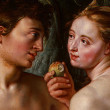
John Farrel recently wrote a column at Forbes.com entitled "Can Theology Evolve?", quoting from an epistle of Jerry Coyne: "I’ve always maintained that this piece of the Old Testament, which is easily falsified by modern genetics (modern humans descended from a group of no fewer than 10,000 individuals), shows more than anything else the incompatibility between science and faith. For if you reject the Adam and Eve tale as literal truth, you reject two central tenets of Christianity:... Read More
Cosmology and Creation: Contrasting Notions
by Fr. Andrew Pinsent
Filed under Cosmology, The Existence of God

NOTE: Yesterday we shared a guest post on cosmology from one of our top non-theistic commenters, Paul Rimmer. Today, we're posting a response from Fr. Andrew Pinsent, Research Director at Oxford University's Ian Ramsey Centre for Science and Religion. As a Catholic priest, and former particle physicist at CERN, I thank Strange Notions for the opportunity to respond to Paul Rimmer’s article on the Big Bang. For those hoping for instant controversy, I am sorry to have to... Read More
Like Nothing You’ve Seen Before: Big Bang Errors and God Errors
by Paul Rimmer
Filed under Cosmology

NOTE: Today we share a guest post on cosmology from one of our top non-theistic commenters, Paul Rimmer. Tomorrow, we'll post a response from Fr. Andrew Pinsent, Research Director at Oxford University's Ian Ramsey Centre for Science and Religion. First things First Many articles about God and cosmology begin with ignorance, and this article will be no different. I'm not a cosmologist. My research involves much of the same mathematical formalism cosmologists use, and... Read More
The Myth of Religious Violence
by Dr. Benjamin Wiker
Filed under Christianity and Violence

One of the enduring myths of the secular state is that religion is so dangerous, so volatile, so likely to burst into conflagrations of violence, that the only protection we have from societal destruction is the erection of a wall that separates religion from the state. We've all heard the story, and in fact, having also heard endless tales of horror about the great religious wars—especially the French Wars of Religion and the Thirty Years War—we might be strongly inclined to believe... Read More
Answering Two Objections to Aquinas
by Trent Horn
Filed under The Existence of God
I'd like to share an excerpt from my new book Answering Atheism, which answers two common objections to Thomas Aquinas’s first way of proving the existence of God. This way is usually called the argument from motion. Objection #1: What moved God? The “new atheists,” like Richard Dawkins, sometimes make a caricature of Aquinas and claim he is arguing that, “Everything needs a cause. Therefore, there had to be a first cause called God. God is the exception and... Read More