The Rational Judgment of a Miraculous Cure
by Kevin Aldrich
Filed under Christianity and Science
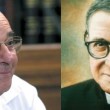
Dr. Manuel Nevado (left) and St. Josemaria Escriva de Balaguer (right). My goal in this post is to show how the Catholic Church made the rational judgment, after serious investigation, that one man received a miracle of healing through the intercession of another. In discussing this “miracle,” I will rely on two definitions of the word miracle. Fr. John Hardon, S.J., wrote: “In theological language, a miracle is an extraordinary event, performed by God, which can be perceived by... Read More
Is God Pro-Life or Pro-Death?
by Dr. Matthew Ramage
Filed under Christianity and Violence, The Bible, The Problem of Evil

This is the second in a series of posts on the “dark passages” of the Bible. These are texts which understandably raise the eyebrows of both nonbelievers and believers who encounter them and say, “How can that be in the Bible if it is God’s own word?” In my previous post I took up the problem of violent Old Testament passages in light of Pope Benedict XVI’s claim that violence is contrary to God’s nature. My book Dark Passages of the Bible likewise deals with this and various... Read More
The Road from Atheism: Dr. Edward Feser’s Conversion (Part 3 of 3)
by Dr. Edward Feser
Filed under Atheism, Conversion
NOTE: On Monday we shared Part 1 of Dr. Edward Feser's conversion story from atheism to theism and on Wednesday we posted Part 2. Today we share the final Part 3. We'd also like to note that Dr. Feser's contributions at Strange Notions were originally posted on his own blog, and therefore lose some of their context when reprinted here. Dr. Feser explains why that matters. Several crucial background elements were in place by the late 90s. Fregean and related arguments had gotten... Read More
The Road from Atheism: Dr. Edward Feser’s Conversion (Part 2 of 3)
by Dr. Edward Feser
Filed under Atheism, Conversion
NOTE: On Monday we shared Part 1 of Dr. Edward Feser's conversion story from atheism to theism. Today we're posting Part 2 and on Monday we'll post Part 3.We'd also like to note that Dr. Feser's contributions at Strange Notions were originally posted on his own blog, and therefore lose some of their context when reprinted here. Dr. Feser explains why that matters. Not that that led me to give up naturalism, at least not initially. A more nuanced, skeptical naturalism was... Read More
The Road from Atheism: Dr. Edward Feser’s Conversion (Part 1 of 3)
by Dr. Edward Feser
Filed under Atheism

NOTE: Today we share the first part of Dr. Edward Feser's conversion story from atheism to theism. We'll post Part 2 this Friday and Part 3 on Monday. We'd also like to note that Dr. Feser's contributions at Strange Notions were originally posted on his own blog, and therefore lose some of their context when reprinted here. Dr. Feser explains why that matters. As many friends and readers know, I was an atheist for about a decade—roughly the 1990s, give or... Read More
The Opening of the Scientific Mind
by Dr. Stacy Trasancos
Filed under Science

David Gelernter wrote an evocative essay for Commentary Magazine (cleverly) titled "The Closing of the Scientific Mind." His essay was a summary of conflicts in modern "philosophy of mind." He criticized the "bullying" against atheist Thomas Nagel who concluded that Darwinian evolution is insufficient to explain consciousness and who was "unwilling" in Gelernter's opinion "to express sufficient hatred of religion to satisfy other atheists." Then Gelernter discussed the "roboticism" of... Read More
Does the Catholic Church Hate Women?
by Dr. Christopher Kaczor
Filed under The Church

The Catholic Church is subjected to a great deal of suspicion, if not outright scorn, when it comes to its treatment of women. Does the Church treat women as "second class"? In short, does the Catholic Church hate women? Few people would put the question that strongly, yet many believe the answer is "yes." As evidence, they point to sexist quotations from Church Fathers and sexist interpretations of Scripture. Even Scripture contains "subordination" passages, such as "Let wives also be... Read More
How Contemporary Physics Points to God
by Fr. Robert Spitzer
Filed under Cosmology
Does modern physics provide evidence for the existence of God? This article presents a general overview of the answer to that question (a more thorough treatment may be found in my recent book, New Proofs for the Existence of God). I will divide the topic into three parts: 1. Can Science Give Evidence of Creation and Supernatural Design? 2. What is the Evidence for a Beginning and What are the Implications for Creation? 3. What is the Evidence of Supernatural Intelligence from Anthropic... Read More
Faith, Reason, and God: A Socratic Dialogue
by Dr. Peter Kreeft
Filed under Faith

NOTE: This fictitious dialogue takes place between two friends, Chris, a Catholic, and Sal, a sincere skeptic, and centers on some basic questions here at Strange Notions regarding faith, reason, and the existence of God. Sal: Chris, before we go any further in our conversations about Christianity, I have to ask you a very basic question. Chris: Ask away. Sal: Do you think this is going to get us anywhere, arguing about religion? Chris: What you mean by "arguing"? Sal: Fighting... Read More
Why Goodness Depends on God
by Bishop Robert Barron
Filed under Morality

One of the most common observations made by opponents of religion is that we don't need God in order to have a coherent and integral morality. Atheists and agnostics are extremely sensitive to the charge that the rejection of God will conduce automatically to moral chaos. Consequently, they argue that a robust sense of ethics can be grounded in the consensus of the human community over time or in the intuitions and sensibilities of decent people. What I would like to do is lay out,... Read More